

2026 FCSS_SASE_AD-24 exam torrent FCSS_SASE_AD-24 Study Guide
Easily pass FCSS_SASE_AD-24 Exam with our Dumps & PDF Test Engine
NEW QUESTION # 22
A customer wants to upgrade their legacy on-premises proxy to a cloud-based proxy for a hybrid network.
Which FortiSASE features would help the customer to achieve this outcome?
- A. secure web gateway (SWG) and inline-CASB
- B. SD-WAN and inline-CASB
- C. SD-WAN and NGFW
- D. zero trust network access (ZTNA) and next generation firewall (NGFW)
Answer: A
Explanation:
For a customer looking to upgrade their legacy on-premises proxy to a cloud-based proxy for a hybrid network, the combination of Secure Web Gateway (SWG) and Inline Cloud Access Security Broker (CASB) features in FortiSASE will provide the necessary capabilities.
Secure Web Gateway (SWG):
SWG provides comprehensive web security by inspecting and filtering web traffic to protect against web-based threats.
It ensures that all web traffic, whether originating from on-premises or remote locations, is inspected and secured by the cloud-based proxy.
Inline Cloud Access Security Broker (CASB):
CASB enhances security by providing visibility and control over cloud applications and services.
Inline CASB integrates with SWG to enforce security policies for cloud application usage, preventing unauthorized access and data leakage.
NEW QUESTION # 23
During FortiSASE provisioning, how many security points of presence (POPs) need to be configured by the FortiSASE administrator?
- A. 0
- B. 1
- C. 2
- D. 3
Answer: A
Explanation:
https://docs.fortinet.com/document/fortisase/latest/administration-guide/751044/appendix-a-fortisase-data- centers#Number
NEW QUESTION # 24
Refer to the exhibit. A company has a requirement to inspect all the endpoint internet traffic on FortiSASE, and exclude Google Maps traffic from the FortiSASE VPN tunnel and redirect it to the endpoint physical Interface.
Which configuration must you apply to achieve this requirement?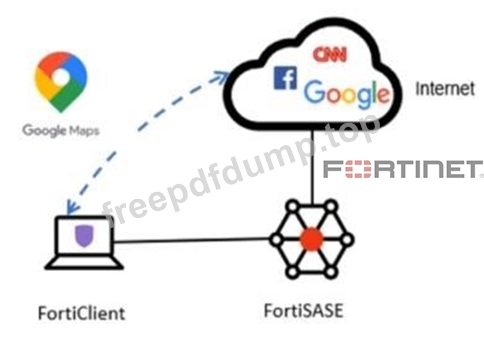
- A. Exempt the Google Maps FQDN from the endpoint system proxy settings.
- B. Configure a static route with the Google Maps FQDN on the endpoint to redirect traffic
- C. Configure the Google Maps FQDN as a split tunneling destination on the FortiSASE endpoint profile.
- D. Change the default DNS server configuration on FortiSASE to use the endpoint system DNS.
Answer: C
Explanation:
To meet the requirement of inspecting all endpoint internet traffic on FortiSASE while excluding Google Maps traffic from the FortiSASE VPN tunnel and redirecting it to the endpoint's physical interface, you should configure split tunneling. Split tunneling allows specific traffic to bypass the VPN tunnel and be routed directly through the endpoint's local interface.
Split Tunneling Configuration:
Split tunneling enables selective traffic to be routed outside the VPN tunnel. By configuring the Google Maps Fully Qualified Domain Name (FQDN) as a split tunneling destination, you ensure that traffic to Google Maps bypasses the VPN tunnel and uses the endpoint's local interface instead.
Implementation Steps:
Access the FortiSASE endpoint profile configuration.
Add the Google Maps FQDN to the split tunneling destinations list. This configuration directs traffic intended for Google Maps to bypass the VPN tunnel and be routed directly through the endpoint's physical network interface.
NEW QUESTION # 25
In FortiSASE, what role do administration settings play in managing distributed endpoints?
Response:
- A. They ensure that devices follow company-wide security policies
- B. They manage the battery life of mobile devices
- C. They control the physical location of devices
- D. They limit access to specific applications only
Answer: A
NEW QUESTION # 26
Which two components are part of onboarding a secure web gateway (SWG) endpoint? (Choose two)
- A. FortiSASE CA certificate
- B. proxy auto-configuration (PAC) file
- C. FortiClient installer
- D. FortiSASE invitation code
Answer: A,B
Explanation:
Onboarding a Secure Web Gateway (SWG) endpoint involves several components to ensure secure and effective integration with FortiSASE. Two key components are the FortiSASE CA certificate and the proxy auto-configuration (PAC) file.
FortiSASE CA Certificate:
The FortiSASE CA certificate is essential for establishing trust between the endpoint and the FortiSASE infrastructure.
It ensures that the endpoint can securely communicate with FortiSASE services and inspect SSL/TLS traffic.
Proxy Auto-Configuration (PAC) File:
The PAC file is used to configure the endpoint to direct web traffic through the FortiSASE proxy.
It provides instructions on how to route traffic, ensuring that all web requests are properly inspected and filtered by FortiSASE.
Reference:
FortiOS 7.2 Administration Guide: Details on onboarding endpoints and configuring SWG.
FortiSASE 23.2 Documentation: Explains the components required for integrating endpoints with FortiSASE and the process for deploying the CA certificate and PAC file.
NEW QUESTION # 27
When deploying FortiSASE agent-based clients, which three features are available compared to an agentless solution? (Choose three.)
- A. ZTNA tags
- B. Anti-ransomware protection
- C. Web filter
- D. SSL inspection
- E. Vulnerability scan
Answer: A,B,E
NEW QUESTION # 28
Refer to the exhibit.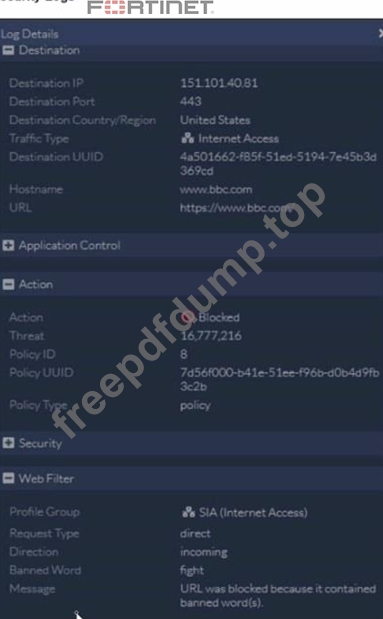
To allow access, which web tiller configuration must you change on FortiSASE?
- A. FortiGuard category-based filter
- B. URL Filter
- C. content filter
- D. inline cloud access security broker (CASB) headers
Answer: C
NEW QUESTION # 29
When viewing the daily summary report generated by FortiSASE, the administrator notices that the report contains very little data.
What is a possible explanation for this almost empty report?
- A. Digital experience monitoring is not configured.
- B. There are no security profile groups applied to all policies.
- C. Log allowed traffic is set to Security Events for all policies.
- D. The web filter security profile is not set to Monitor.
Answer: C
Explanation:
The issue of an almost empty daily summary report in FortiSASE can often be traced back to how logging is configured within the system. Specifically, if "Log Allowed Traffic" is set to "Security Events" for all policies, it means that only security-related events (such as threats or anomalies) are being logged, while normal, allowed traffic is not being recorded. Since most traffic in a typical network environment is allowed, this configuration would result in very little data being captured and subsequently reported in the daily summary.
Here's a breakdown of why the other options are less likely to be the cause:
B . There are no security profile groups applied to all policies: While applying security profiles is important for comprehensive protection, their absence does not directly affect the volume of data in reports unless specific logging settings are also misconfigured.
C . The web filter security profile is not set to Monitor: This option pertains specifically to web filtering activities. Even if web filtering is not set to monitor mode, other types of traffic and logs should still populate the report.
D . Digital experience monitoring is not configured: Digital Experience Monitoring (DEM) focuses on user experience metrics rather than general traffic logging. Its absence would not lead to an almost empty report.
To resolve this issue, administrators should review the logging settings across all policies and ensure that "Log Allowed Traffic" is appropriately configured to capture the necessary data for reporting purposes.
Reference:
Fortinet FCSS FortiSASE Documentation - Reporting and Logging Best Practices FortiSASE Administration Guide - Configuring Logging Settings
NEW QUESTION # 30
Which feature of FortiSASE is most beneficial for securing remote users in a hybrid network?
Response:
- A. Local breakout optimization
- B. Centralized management interface
- C. End-to-end encryption
- D. Direct internet access
Answer: D
NEW QUESTION # 31
What features make Zero Trust Network Access (ZTNA) within FortiSASE different from traditional access methods?
(Select all that apply)
Response:
- A. Application-level access controls
- B. Network-level encryption
- C. Device posture checks
- D. Persistent connectivity
Answer: A,C
NEW QUESTION # 32
What role does FortiSASE play in proactive threat detection?
Response:
- A. It provides real-time analytics to detect unusual patterns
- B. It tracks physical locations of devices
- C. It increases network speed
- D. It reduces hardware requirements
Answer: A
NEW QUESTION # 33
Refer to the exhibit.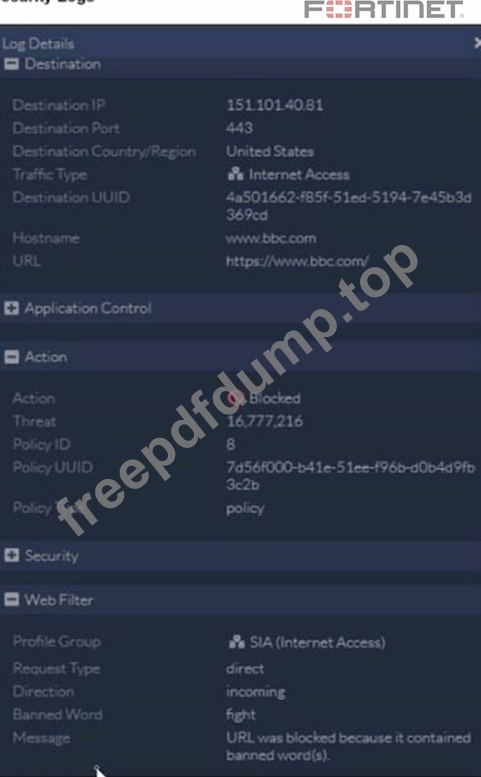
To allow access, which web tiller configuration must you change on FortiSASE?
- A. FortiGuard category-based filter
- B. URL Filter
- C. content filter
- D. inline cloud access security broker (CASB) headers
Answer: C
NEW QUESTION # 34
For a SASE deployment, what is a crucial step when configuring security checks for regulatory compliance?
Response:
- A. Continuous monitoring and automatic updates of compliance rules
- B. Periodic rollback of security updates
- C. Annual reviews of compliance status
- D. Manual verification by external auditors
Answer: A
NEW QUESTION # 35
What is the role of Firewall as a Service (FWaaS) in FortiSASE architecture?
Response:
- A. To monitor and log all user activities
- B. To encrypt traffic between endpoints
- C. To handle DNS queries and responses
- D. To perform content inspection and enforce security policies
Answer: D
NEW QUESTION # 36
Zero Trust Network Access (ZTNA) within FortiSASE restricts access to applications based on user identity and device posture.
Response:
- A. False
- B. True
Answer: B
NEW QUESTION # 37
What aspects should be considered when configuring logging settings in FortiSASE?
(Select all that apply)
Response:
- A. Privacy settings for sensitive information
- B. Log rotation frequency
- C. Debug level logs for everyday operations
- D. Error and event logs
Answer: A,B,D
NEW QUESTION # 38
Which secure internet access (SIA) use case minimizes individual endpoint configuration?
- A. SIA for SSL VPN remote users
- B. Agentless remote user internet access
- C. Site-based remote user internet access
- D. SIA using ZTNA
Answer: B
Explanation:
The agentless remote user internet access use case is designed to minimize individual endpoint configuration. In this scenario, FortiSASE provides secure internet access without requiring the installation of an agent on the endpoint device. This approach is particularly useful for environments with unmanaged devices or temporary users, as it eliminates the need for complex configurations on each endpoint. Instead, security policies are enforced at the network level, ensuring consistent protection without relying on endpoint-specific software.
NEW QUESTION # 39
Refer to the exhibits.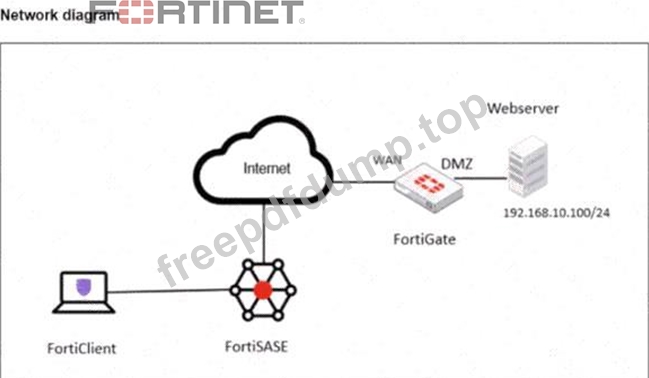
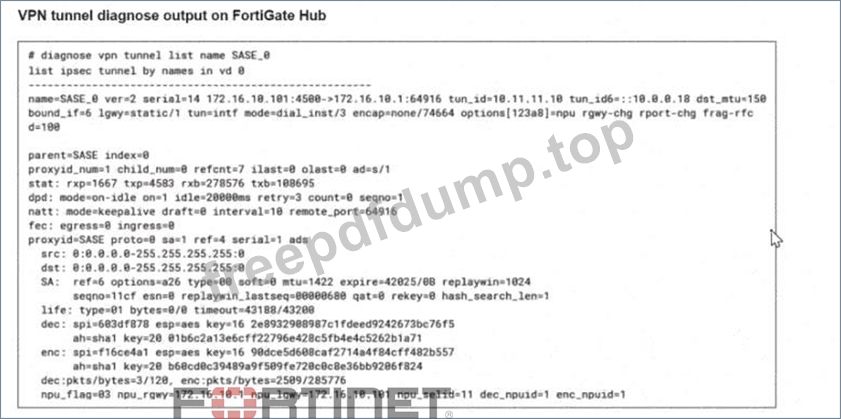
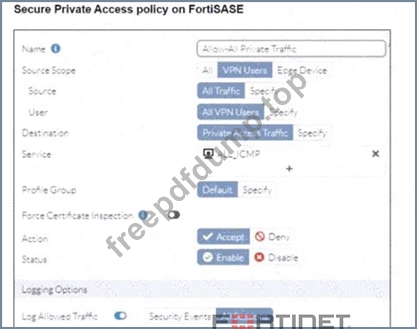
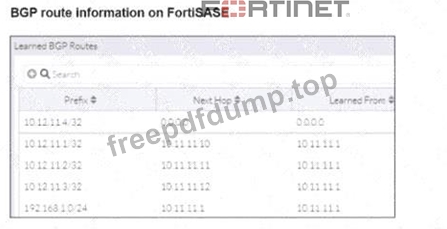
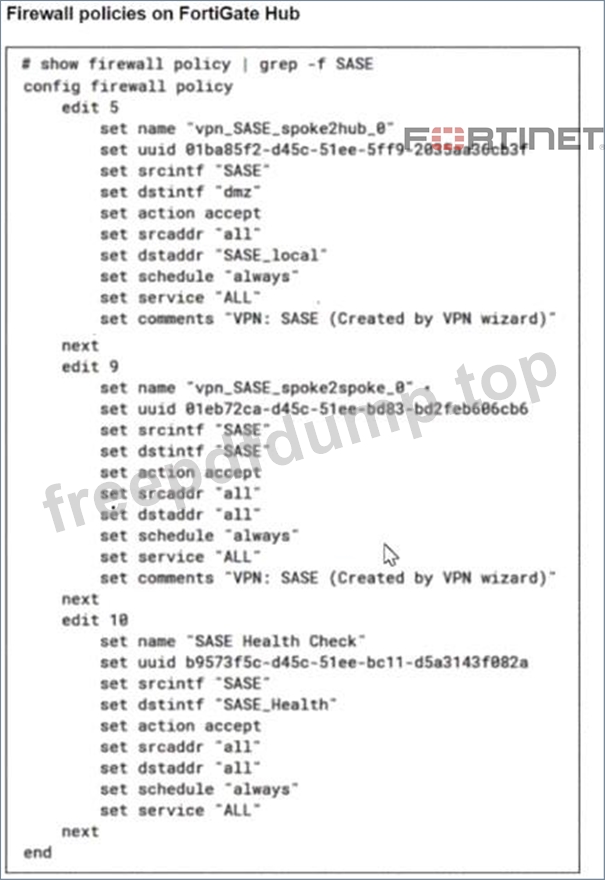
A FortiSASE administrator is trying to configure FortiSASE as a spoke to a FortiGate hub. The tunnel is up to the FortiGale hub. However, the administrator is not able to ping the webserver hosted behind the FortiGate hub.
Based on the output, what is the reason for the ping failures?
- A. The BGP route is not received.
- B. Quick mode selectors are restricting the subnet.
- C. Network address translation (NAT) is not enabled on the spoke-to-hub policy.
- D. The Secure Private Access (SPA) policy needs to allow PING service.
Answer: A
NEW QUESTION # 40
An organization needs to resolve internal hostnames using its internal rather than public DNS servers for remotely connected endpoints. Which two components must be configured on FortiSASE to achieve this?
(Choose two.)
- A. SSL deep inspection
- B. Split DNS rules
- C. DNS filter
- D. Split tunnelling destinations
Answer: A,B
Explanation:
To resolve internal hostnames using internal DNS servers for remotely connected endpoints, the following two components must be configured on FortiSASE:
* Split DNS Rules:
* Split DNS allows the configuration of specific DNS queries to be directed to internal DNS servers instead of public DNS servers.
* This ensures that internal hostnames are resolved using the organization's internal DNS infrastructure, maintaining privacy and accuracy for internal network resources.
* Split Tunneling Destinations:
* Split tunneling allows specific traffic (such as DNS queries for internal domains) to be routed through the VPN tunnel while other traffic is sent directly to the internet.
* By configuring split tunneling destinations, you can ensure that DNS queries for internal hostnames are directed through the VPN to the internal DNS servers.
References:
FortiOS 7.2 Administration Guide: Provides details on configuring split DNS and split tunneling for VPN clients.
FortiSASE 23.2 Documentation: Explains the implementation and configuration of split DNS and split tunneling for securely resolving internal hostnames.
NEW QUESTION # 41
What are the key features of ZTNA that differentiate it from traditional VPN solutions?
Response:
- A. Network level encryption
- B. Persistent session connectivity
- C. Application-level access controls
- D. Device posture checks
Answer: C,D
NEW QUESTION # 42
Which technology is used with IPsec for spoke-to-spoke connectivity in a Secure Private Access (SPA) with SD-WAN deployment?
- A. EBGP
- B. EVPN
- C. ADVPN
- D. OVTEP
Answer: C
NEW QUESTION # 43
In configuring SASE, what is an essential consideration for applying compliance rules related to data protection?
Response:
- A. Avoiding encryption to ensure easier regulatory inspection
- B. Tailoring rules based on local legal requirements
- C. Implementing uniform rules across all geographic regions
- D. Using default settings for ease of deployment
Answer: B
NEW QUESTION # 44
Which FortiSASE component can be utilized for endpoint compliance?
Response:
- A. cloud access security broker (CASB)
- B. zero trust network access (ZTNA)
- C. secure web gateway (SWG)
- D. Firewall-as-a-Service (FWaaS)
Answer: B
NEW QUESTION # 45
......
FCSS_SASE_AD-24 PDF Pass Leader, FCSS_SASE_AD-24 Latest Real Test: https://www.freepdfdump.top/FCSS_SASE_AD-24-valid-torrent.html
Valid FCSS_SASE_AD-24 Test Answers & FCSS_SASE_AD-24 Exam PDF: https://drive.google.com/open?id=1kqRLZLF6bAlkA55peomHPhd9vNsd_GFk
