

VALID L4M8 Exam Dumps For Certification Exam Preparation
L4M8 Dumps PDF 2026 Strategy Your Preparation Efficiently
CIPS L4M8 exam is ideal for professionals who are looking to advance their careers in procurement and supply chain management. It is also an excellent choice for those who want to gain a comprehensive understanding of the procurement process and how it relates to other areas of the business. The CIPS L4M8 exam is recognized globally and is highly valued by employers in the procurement and supply chain industry.
CIPS L4M8 exam is an essential certification for procurement professionals who want to demonstrate their ability to apply procurement and supply chain principles in practice. L4M8 exam is designed to test the candidates' knowledge of procurement and supply chain management concepts, principles, and practices, and their ability to apply them in real-life scenarios.
NEW QUESTION # 13
Using the case study about Toyata, which type of benchmarking Tada has used when comparing the Toyata with Porsche?
Answer:
Explanation:
See the answer in explanation.
Explanation:
Benchmarking is the process of comparing a function, process or performance with another which is best-in- class. Benchmarking is either internal or external. External benchmarking has three types; 1) Competition benchmarking, 2) Functional 3) Generic Company Toyota with the Porsche a competition in the same industry and by suggesting that drives will find the cars performances comparable with that of Porsche Cayman sports car, suggest think it is an external competitive benchmark.
NEW QUESTION # 14
Why is it important to have adequate procedures in place within an organization in relation to bribery?
Answer:
Explanation:
Bribery is the act of giving someone something of value to persuade them to do something that benefits you.
Ethical and responsible sourcing requires conducting due diligence on bribery before going into contractual relationship because failure to this might lead to loss in reputation.
In other for an organization to defend itself against a case of suspected bribery, the United Kingdom bribery Act introduced in 2010 suggests that organizations should have adequate procedures' in place.
The following are six procedures an organization should have in place to be able to defend itself against bribery
1) Proportionate procedure
2) Top level commitment
3) risk assessment
4) due diligence
5) communication
6) monitoring and reviewing
* Refer to the question column for response
NEW QUESTION # 15
What is business case?
Answer:
Explanation:
A business case is a document containing the justification and the commercial benefits achievable for a potential project or an identified need, for example, the purchase of a capital equipment, con-struction of an additional warehouse or procuring more innovative software to replace the current on in use.
The essence of the business case is to obtain support and get buy-in from senior management.
In order to gain authority to apply whole life asset management a business case will need to be created and presented. A developed business case will cover the following element.
1) Introduction: Outline of what the business case is all about
2) Objective: Explanation of what the business case desired outcome is.
3) Approach that will be undertaken
4) List of resources required
5) Benefits of achieving the objective
* Refer to the question column for response
NEW QUESTION # 16
Explain how influencing, can relate to corruption within procurement.
Answer:
Explanation:
See the answer in explanation.
Explanation:
Influencing is the capacity to be able to change behavior or opinions, either consciously or subconsciously.
As outlined by Yukl and falbets work from 1990 influencing can relate to corruption within pro-curement in these six ways.
1)A party can be assertive (forceful, directive, using deadlines),
2) Ingratiating i.e. using charm and flattery.
3) Exchange-Trading favors,
4) Upward appeal (requesting input for senior management not only that influencing can come as
5) Coalition; team members uniting for support.
5) Rational persuasion, i.e. bringing in logic and facts for clarification.
NEW QUESTION # 17
Which theory relates to the 3Ps
Answer:
Explanation:
See the answer in explanation.
Explanation:
Trying to measure how sustainable an organization was use to be challenging undertaking. However, during the 1990s, a concept brought up by American John Elkington change the way sustainability was measured.
This framework is known as the triple bottom line (TBL) and measures sustainability in relation to organizational performance and investment against the 3Ps (1) Profits (2) People (3) Planet. For example; Profit: A packaging manufacturer reinventing its profits in a State- of-the-art recycling machinery for it wasted cardboard.
People: A large privately owned call centre donate its end of life computers to a local youth clubs and social groups to help gain internet cases.
NEW QUESTION # 18
In relation to the case study 'Walmart and H & M in spotlight regarding human rights in media ex-plain which human rights are not being granted to the workers.
Answer:
Explanation:
Human rights are the statutory ways in which individual expects to and should be treated. Ethical and responsible sourcing includes the protection of human rights, not violating it.
When young women are being bound into contracts where they work for two to three years, they are not being granted the right to freedom from slavery.
Forcing these women to live in hostels under restrictions that prevent them from moving and are denied the opportunity to improve on their living condition is a violation of their right to life, liberty and personal security, also, their freedom from torture and degrading treatment is being violated.
* Refer to the question column for response
Case Study
A series of news stories reporting events such as the collapse of the Rana Plaza building in 2013 have drawn attention to the poor conditions in garment factories across India and South East Asia. Human rights groups have long be critical of the excessive hours and poor wages workers are forced to endure, as well as the abuse they receive from supervisor. With consumers becoming increasingly aware of these conditions, more pressure is being put on global brands and retailers to ensure their supply chains are fair and ethical.
Certain areas have been notorious for the mistreatment of workers. In India's textile valley', young women are been bound into contracts where they work for two to three years, in exchange for a lump sum of money that they can then put towards a dowry. This is known as the 'Sumangali [a married woman] Thittam' scheme. These women are forced to live in hostels under restrictions that prevent them from moving, and are denied the opportunity to improve their living conditions. Retailers including Walmart and H & M are known to source garments from factories in the 'textile valley'.
Reports by organizations including the Asia Floor Wage Alliance (AFWA), Central Combodia, Global Labor Justice, Sedane Labour Resource Centre (LIPS) Indonesia, and Society for Labour and Development (SLD) India have exposed unethically run factories that supply garments to H & M, Gap and Walmart. However, retailers will continue to benefit from expensive labour until mounting customers pressure causes them to change.
NEW QUESTION # 19
Explain why you think quality should be investigated before working with potential supplier?
Answer:
Explanation:
Quality is fitness for purpose. It is important that quality is investigated by procurement professionals before forming relationship with potential supplies.
If quality is not investigated before selecting supplier the organization might stand the risk of facing the following disadvantages; Reputational Damages Cost of Rework Cost of Downtime Cost of Material Cost of being stocked with the wrong supplier Cost of being stocked in a project that may not come to an end at the forecasted time.
How buyer can choose a supplier with a good quality culture is first by defining the quality of the product or services to be carried out .Having knowledge of the product or service quality, supplies can rightly select and evaluated supplier with total quality management (TQM) in their system, ISO 9001 accreditation. TQM includes everyone in the organization with knowledge on the required quality; there would be little or no rejection/reworks. Thus is an added value to the organization.
* Refer to the question column for response
NEW QUESTION # 20
Describe what should be considered when creating damages terms in a contract.
Answer:
Explanation:
See the answer in explanation.
Explanation:
Damages are 'sum of money that the supplier pays if it fails to carry out its contractual obligation.
When creating terms for damages in the contract, it should be considered that Damages are categorized into two types (liquidated and un-liquidated). And which or if both are applicable to the contract in hand.
Liquidate Damages are fixed amount of money agreed between the parties that is payable if a contract is breached. For example, knowing that supplier not being able to install a device properly in a power transformer may destroy the device and going ahead to include a fee in the contract if the device was destroyed.
Un-liquidated damages are unfixed amount of money. It is used when the amount of money that will compensate the injured party cannot be known in advance. A court decides the amount when the damages occur. For example, knowing that supplier not being able to install a device properly in a power transformer may destroy the device, other appliances and equipment unknown, cause the buyer delay in the process and reputational damage as in customer dissatisfaction. Yet, unquantifiable as both parties are unable to fix a fee in advance on the damages and leaving it to the court to decide the damage if it may occur.
* Refer to the question column for response
NEW QUESTION # 21
KPI should be written to match which area of an organization?
Answer:
Explanation:
Key performance indicator (KPI) is another method of monitoring how a supplier is delivering on a contract.
When creating KPIs to manage suppliers and their contracts the areas monitored should be related to the organization's overall strategy that is where organization's success will be measured.
NEW QUESTION # 22
Create a list of primary and secondary Data sources?
Answer:
Explanation:
Data can be primary or secondary
Primary data are derived from original work or research through experience. Primary data can be gathered from the following sources; 1) Interview (2) survey (3) meetings (4) case studies.
Secondary data is derived from a previous source, i.e. somebody else has gathered the data. Sec-ondary data can be gained from; (1) Books (2) Websites, Trade magazines, etc
NEW QUESTION # 23
Describe two ways in which an organization with which you are familiar could use continuous im-provement as part of whole life asset management.
Answer:
Explanation:
See the answer in explanation.
Explanation:
Continuous improvement relates to removing waste from the supply chain and improving processes to increase efficiency within whole life asset management in a full power project (a flour producing firm) can benefit from continuous improvement in the following ways;
1) Reduce cost of spears by recondition parts, instead of disposing them out rightly.
2) Can reduce down time by conducting routine maintenance after hours.
3) Can reducing accident by up skilling operators on safety
4) Can reduce waste oil by following owner's manual instead of relying on experience.
5) Create efficiencies by operating a 24/7 shift pattern.
NEW QUESTION # 24
What do STEEPLE and SWOT stand for?
Answer:
Explanation:
See the answer in explanation.
Explanation:
RESPONSE
After a need in an organization has been identified/understood, defined, justified and authorized, the next stages are to understand how commodity prices are reacting, which suppliers are available and their strength.
The make or buy decision can be reached with knowledge from this; the procurement professional can consider the organization external environment, strength, weakness opportunity and threat to develop strategy
/plan of how to achieve the procurement.
'STEEPLE' is an effective way to evaluate the external environment. It helps buyers to assess factors that could affect the need in hand and helps them to develop the plan accordingly. 'STEEPLE' is an acronym which stands for, Social, Technology, Economic, Environment, Political, Legal, Ethical
'SWOT' helps the organization to analyze its strength and within the organization and the oppor-tunity and threats outside the organization.
'SWOT' is an acronym which stands for, strength, weakness, opportunity and threats.
* Refer to the question column
NEW QUESTION # 25
Describe one implied term and one expressed term from a contract with which you are familiar.
Answer:
Explanation:
See the answer in explanation.
Explanation:
Terms are the right and duties agreed between parties which are then documented in contract. Terms can be implied or expressed.
Implied terms are always present in a contract and are set by national laws; implied terms do not have to be written or verbally agreed : they always exist, for example sales of Gods Act, good being fit for purpose, Negligence, confidence, whereas expressed terms are negotiated and agreed rather than being automatically included, express terms are agreed between, parties negotiating the contract. For example; payment terms, specification, delivery detail and quantities
NEW QUESTION # 26
What are the four quadrants within the Kraljic portfolio matrix?
Answer:
Explanation:
At the early stages In procurement and supply cycle, buyers begin segmenting current supplies in the categories, depending on their level of integration into the organization. To help get this done, the buyer may use the Kraljic portfolio matrix. The kraljic portfolio matrix segment suppliers into four categories, which are;
1) Routine 2) Bottleneck 3) Leverage 4)strategic supplier
NEW QUESTION # 27
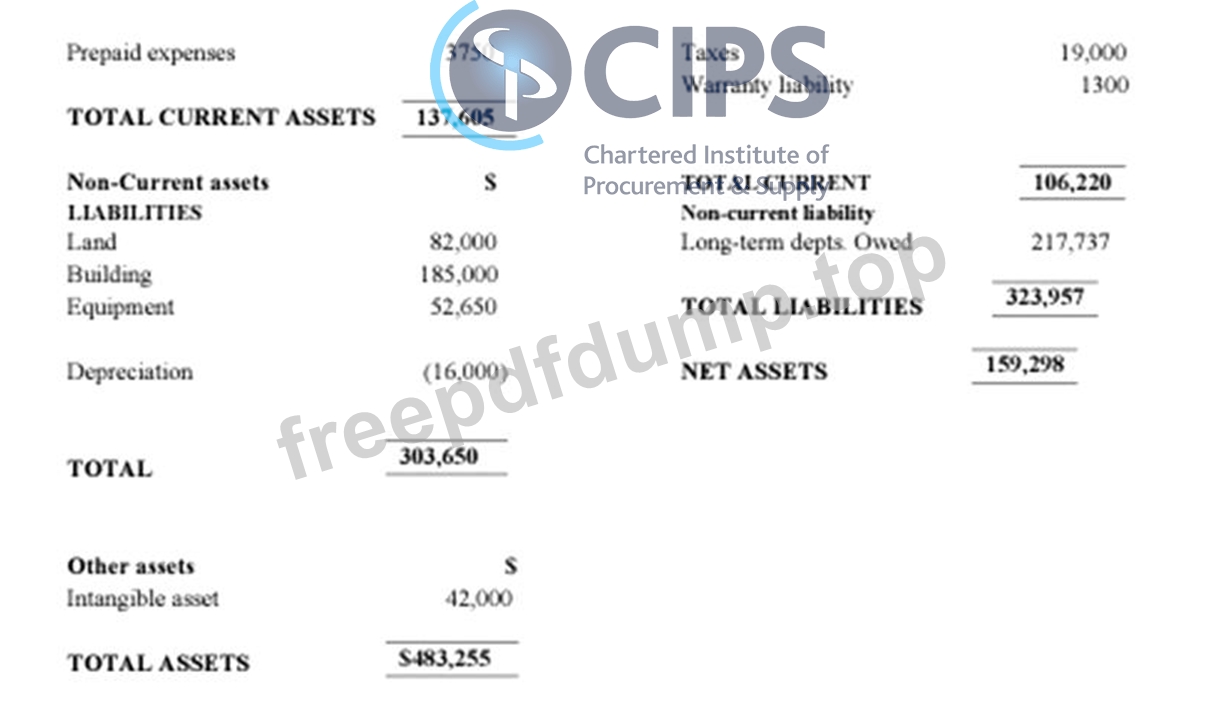
Use the balance sheet below to work out the correct ratio for coffee Time and explain whether the company appears to have enough assets to cover it liability.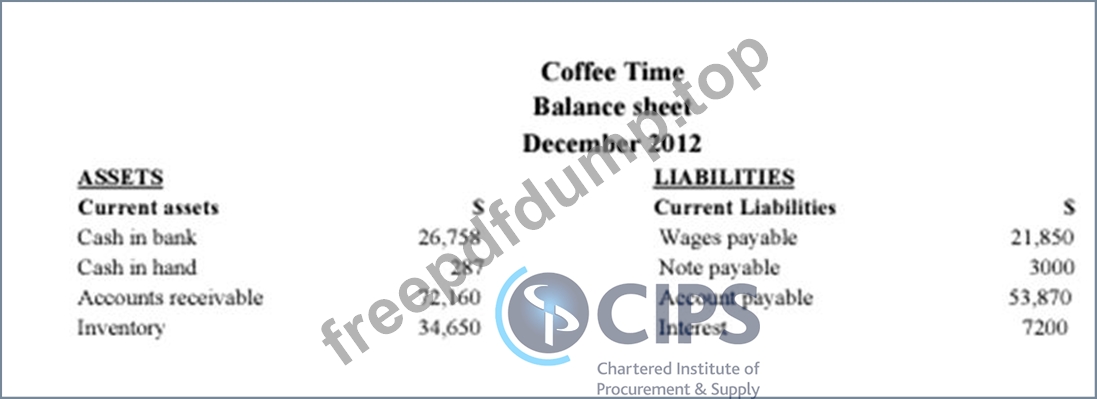
Answer:
Explanation:
The current ratio is one of the two was to determine organizations liquidity (how quickly its assets can be converted into cash)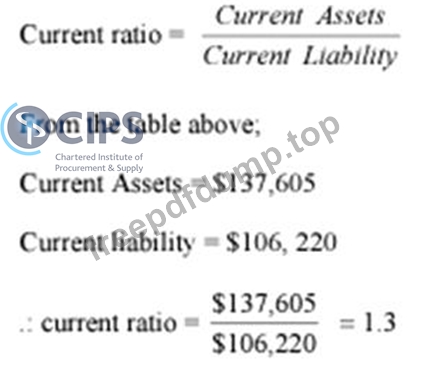
A current ratio of 1 shows that the organization has enough assets to repay (cover) it liability Buyers can be encouraged to deal with these suppliers after if they considered proven and strong in other areas.
NEW QUESTION # 28
Which type of power is most likely to be used in corruption?
Answer:
Explanation:
See the answer in explanation.
Explanation:
The abuse of power within the supply chain can be linked to corruption. If individuals with seniority favor one supplier over another, they can exercise their power to award the contract to whoever they wish.
According to CIPS code of conduct, this is not acceptable.
According to French and Raven, there are five types of power (Legitimate power, Reward, Expert, Referent and Coercive), and these powers can most likely be used in corruption.
NEW QUESTION # 29
What is contract performance review and continuous improvement?
Answer:
Explanation:
See the answer in explanation.
Explanation:
Contract performance review and continuous improvement is the stage 11 of the CIPS procurement and supply cycle.
In order to effectively manage supplier performance and contractual obligations, the suppliers per-formance against key performance indicators (KPI) should be reviewed regularly. This KPI should have been agreed doing the post contract award negotiation. In addition to review KPIs suppliers and the procurement team should work towards continuous improvement. This is a continuous ef-fort to improve product or services within an organization. This may involve improving quality, reducing waste in the supply chain and focusing on innovation. It is an ongoing process that works toward perfection.
* Refer to the question column for response
NEW QUESTION # 30
What is Decommissioning?
Answer:
Explanation:
See the answer in explanation.
Explanation:
When a fixed asset reaches the end of its life, it requires decommissioning before reconditioning or disposal.
Decommissioning is to observe all the safety measures and technical procedures and stop active machinery or an asset from operation (example; gas plant, power generator, transformer etc.
Decommissioning process include the following aspect
1) Preparation: Plan the process
2) Dismantle: Take the asset apart and remove hazardous waste
3) Processing: make safe any hazardous waste
4) Disposal: Ensure paper work is received to confirm removal and disposal
NEW QUESTION # 31
What two areas of an organization do the Kraljic Portfolio matrix uses to establish the category of a product or service?
Answer:
Explanation:
The Kraljic Portfolio Matrix shows where a product or services fits into in an organization. It is based on two areas 1) the risk of supply (Risk Impact). 2) Effect it has on profit (cost impact).
NEW QUESTION # 32
Write all of factors that contribute towards value for a product that you regularly purchase.
Answer:
Explanation:
See the answer in explanation.
Explanation:
Factors that contribute towards value for clothe gum in a fashion firm;
1) How much money does the gum cost?
2) How much is the benefits of using the clothe gum?
3) Does customers prefer clothe gum at the bottom of their garment?
4) Is the clothe gum difficult to use?
5) Does the clothe gum beautifies the fabric when placed properly?
6) Does it give a better finishing?
7) Is it ethical to use?
8) Is it from a sustainable source?
9) is it environmental friendly?
10) Does using clothe gum suggest innovation in fashion?
Refer to the question column for response
NEW QUESTION # 33
What is the method of monitoring suppliers?
Answer:
Explanation:
See the answer in explanation.
Explanation:
When a contract has been awarded, either is to meet tangible needs or intangible needs, contractors or suppliers should be managed to ensure that they are meeting up with fulfilling their contractual agreement. To establish this, there are methods of managing contracts and suppliers.
Service level agreement (SLA) clauses: is placed in contract to ensures that supplier meets the expected and agreed level of service Key performance indicator (KPI): are used to manage contracts that fulfill tangible needs, the KPIs are set performance thresholds that are used to monitor supplier's performance.
Management by objectives (MBO): is the process of defining objective that are strategic to the organization relating them to the vision and mission and communicating them to the supplier through the contract and ensuring that this objective is met during contract performance.
Reviews: Regular supplier reviews are good practices, for it gives the buyer opportunity to give feedback on performance.
Continuous Improvement: Contracts and suppliers can be monitored through how they are chang-ing for better incrementally as they are fulfilling the schedule. There must be a set down system to timely improve on the process, people and continuously reduce waste.
Training: It is essential that training, are provided to come up on areas supplier is lacking.
* Refer to the question column for response
NEW QUESTION # 34
......
Latest Verified & Correct L4M8 Questions: https://www.freepdfdump.top/L4M8-valid-torrent.html
100% Pass Guaranteed Download CIPS Level 4 Diploma in Procurement and Supply Exam PDF Q&A: https://drive.google.com/open?id=1znJYBw5VBWMFbfX5_moD0jiNTwi523nL
