

[Apr-2025] Use Real 2V0-72.22 Dumps - 100% Free 2V0-72.22 Exam Dumps
2V0-72.22 PDF Dumps Exam Questions – Valid 2V0-72.22 Dumps
NEW QUESTION # 19
Which statement is true about the @PropertySource annotation? (Choose the best answer.)
- A. Used to easily look up and return a single property value from some external property file.
- B. Used to designate the location of the application.properties file in a Spring Boot application.
- C. Used to add a set of name/value pairs to the Spring Environment from an external source.
- D. Used to designate the file directory of the application.properties file in a Spring Boot application.
Answer: A
NEW QUESTION # 20
Which following statements are true about Spring Data? (Choose two.)
- A. Spring Data implementations exist for many data storage types, such as MongoDB, Neo4j, and Redis.
- B. Spring Data cannot be used together with Spring MVC.
- C. Spring Data works by applying the JPA annotations to data stores such as MongoDB, Neo4j, and Redis.
- D. Spring Data can greatly reduce the amount of "boilerplate" code typically needed for data access.
- E. Spring Data is specifically designed for JPA, JDBC, and relational database access only.
Answer: D,E
NEW QUESTION # 21
Which two statements describe the ApplicationContext correctly? (Choose two.)
- A. The ApplicationContext is the root interface for accessing the Spring container.
- B. The ApplicationContext maintains singleton beans that are instantiated by the Spring runtime.
- C. The ApplicationContext lazy initializes beans by default.
- D. The ApplicationContext can be created in a test environment, web application, and in a standalone application.
- E. The ApplicationContext does not include all functionality of the BeanFactory.
Answer: A,D
NEW QUESTION # 22
Which two statements are correct regarding Spring Boot auto-configuration? (Choose two.)
- A. Auto-configuration is applied before user-defined beans have been registered.
- B. Auto-configuration is applied by processing candidates listed in META-INF/spring.factories.
- C. Auto-configuration could apply when a bean is present but not when a bean is missing.
- D. Auto-configuration could apply when a bean is missing but not when a bean is present.
- E. Auto-configuration uses @Conditional annotations to constrain when it should apply.
Answer: A,C
NEW QUESTION # 23
Which two statements describe Spring JdbcTemplate? (Choose two.)
- A. The JdbcTemplate can only perform update but not insert to the database.
- B. All JdbcTemplate methods throw SQLException which you are required to handle.
- C. The JdbcTemplate provides methods for query execution.
- D. The JdbcTemplate provides the ability to work with result sets.
- E. The JdbcTemplate generates SQL statements.
Answer: C,D
Explanation:
This is true because Spring's JdbcTemplate class offers a variety of methods to execute SQL queries against a relational database. These include methods for executing SQL queries (query, queryForObject, queryForList, etc.), updates (update), and batch operations (batchUpdate).
NEW QUESTION # 24
Which strategy is correct for configuring Spring Security to intercept particular URLs? (Choose the best answer.)
- A. The URLs can be specified via configuration (using authorizeRequests () and request matchers), with the least specific rule first and the most specific last.
- B. The URLs are specified in a special properties file, used by Spring Security.
- C. Spring Security can obtain URLs from Spring MVC controllers, the Spring Security configuration just needs a reference to the controller to be protected.
- D. The URLs can be specified via configuration (using authorizeRequests () and request matchers), with the most specific rule first and the least specific last.
Answer: D
NEW QUESTION # 25
Refer to the exhibit.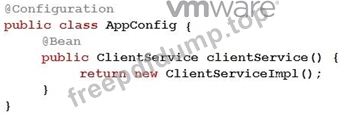
What is the id/name of the declared bean in this Java configuration class? (Choose the best answer.)
- A. clientServiceImpl (starting with lowercase "c")
- B. clientServiceImpl (starting with uppercase "C")
- C. ClientService (starting with uppercase "C")
- D. clientService (starting with lowercase "c")
Answer: C
NEW QUESTION # 26
Which two statements are true regarding Spring Boot Testing? (Choose two.)
- A. @TestApplicationContext is used to define additional beans or customizations for a test.
- B. Test methods annotated with @SpringBootTest will recreate the ApplicationContext.
- C. @SpringBootTest is typically used for integration testing.
- D. @SpringBootTest without any configuration classes expects there is only one class annotated with @SpringBootConfiguration in the application.
- E. Test methods in a @SpringBootTest class are transactional by default.
Answer: C,D
NEW QUESTION # 27
Refer to the exhibit.
It is a Java code fragment from a Spring application. Which statement is true with regard to the above example? (Choose the best answer.)
- A. This syntax is invalid because the result of the getBean() method call should be cast to ClientService.
- B. It will return a bean of the type ClientService regardless of its id or name.
- C. It will return a bean called ClientService regardless of its id or name.
- D. This syntax is invalid because the bean id must be specified as a method parameter.
Answer: B
Explanation:
https://www.baeldung.com/spring-getbean#3-retrieving-bean-by-type
NEW QUESTION # 28
Which two statements are true regarding storing user details in Spring Security? (Choose two.)
- A. With a custom UserDetailsService defined in the ApplicationContext, Spring Boot still creates the default user.
- B. The user details includes username and password but not authorities.
- C. User details can be stored in a database, in LDAP, or in-memory.
- D. User details can be stored in custom storage and retrieve them by implementing the UserDetailsService interface.
- E. Passwords must be hashed and the default hashing algorithm is MD5.
Answer: A,B
NEW QUESTION # 29
Which two statements are correct regarding Spring Boot 2.x Actuator Metrics? (Choose two.)
- A. Custom metrics can be measured using Meter primitives such as Counter, Gauge, Timer, and DistributionSummary.
- B. The metrics endpoint /actuator/metrics is exposed over HTTP by default.
- C. A metric must be created with one or more tags.
- D. Timer measures both the number of timed events and the total time of all events timed.
- E. An external monitoring system must be used with Actuator.
Answer: B,E
NEW QUESTION # 30
Which three types can be used as @Controller method arguments? (Choose three.)
- A. HttpSession
- B. Request
- C. Principal
- D. Language
- E. Session
- F. Locale
Answer: A,B,F
NEW QUESTION # 31
Which two options will inject the value of the daily.limit system property? (Choose two.)
- A. @Value("#{systemProperties['daily.limit']}")
- B. @Value("$(daily.limit)")
- C. @Value("#{daily.limit}")
- D. @Value("$(systemProperties.daily.limit)")
- E. @Value("#{systemProperties.daily.limit}")
Answer: A,B
Explanation:
The @Value annotation can be used to inject values from external sources into fields, constructor parameters, or method parameters. To inject a system property, the annotation can use either the ${...} placeholder syntax or the #{...} SpEL expression syntax. The former is simpler and more concise, while the latter is more powerful and flexible. Both syntaxes can access the systemProperties map, which contains all the system properties as key-value pairs.
NEW QUESTION # 32
Which two statements are correct regarding Spring Boot auto-configuration? (Choose two.)
- A. Auto-configuration is applied by processing candidates listed in META-INF/spring.factories.
- B. Auto-configuration could apply when a bean is present but not when a bean is missing.
- C. Auto-configuration uses @Conditional annotations to constrain when it should apply.
- D. Auto-configuration could apply when a bean is missing but not when a bean is present.
- E. Auto-configuration is applied before user-defined beans have been registered.
Answer: A,C
NEW QUESTION # 33
Which two statements are true concerning constructor injection? (Choose two.)
- A. Construction injection can be used with multiple constructors without @Autowired annotation.
- B. Constructor injection is preferred over field injection to support unit testing.
- C. Field injection is preferred over constructor injection from a unit testing standpoint.
- D. Constructor injection only allows one value to be injected.
- E. If there is only one constructor the @Autowired annotation is not required.
Answer: B,E
Explanation:
Constructor injection is one of the ways to inject dependencies into a bean using its constructor parameters. Since Spring 4.3, if a bean has only one constructor, the @Autowired annotation can be omitted and Spring will use that constructor by default.
Constructor injection is generally recommended over field injection because it makes the dependencies of a bean explicit and immutable. It also facilitates unit testing because it allows us to easily provide mock dependencies through constructor arguments.
NEW QUESTION # 34
Which two statements are correct regarding the @EnableAutoConfiguration annotation? (Choose two.)
- A. It enables auto-configuration of the ApplicationContext by attempting to guess necessary beans.
- B. It is a meta-annotation on the @SpringBootApplication composed annotation.
- C. It ensures auto-configuration is applied before user-defined beans have been registered.
- D. It is meta-annotation on the @SpringBootConfiguration composed annotation.
- E. It has the same effect regardless of the package of the class that is annotated with it.
Answer: B,E
NEW QUESTION # 35
Which option is true about use of mocks in a Spring Boot web slice test? (Choose the best answer.)
- A. Mocking a Spring Bean requires annotating it with @MockBean annotation.
- B. Mocks cannot be used in a Spring Boot web slice test.
- C. Mocking a Spring Bean requires annotating it with @Mock annotation.
- D. If a Spring Bean already exists in the web slice test spring context, it cannot be mocked.
Answer: A
NEW QUESTION # 36
Which strategy is correct for configuring Spring Security to intercept particular URLs? (Choose the best answer.)
- A. The URLs can be specified via configuration (using authorizeRequests () and request matchers), with the least specific rule first and the most specific last.
- B. The URLs are specified in a special properties file, used by Spring Security.
- C. Spring Security can obtain URLs from Spring MVC controllers, the Spring Security configuration just needs a reference to the controller to be protected.
- D. The URLs can be specified via configuration (using authorizeRequests () and request matchers), with the most specific rule first and the least specific last.
Answer: D
Explanation:
Spring Security provides a fluent API for configuring web security based on URL patterns and request matchers. The authorizeRequests() method returns an expression that allows specifying access rules for different URLs using methods such as antMatchers(), regexMatchers(), mvcMatchers(), etc. The order of these rules matters, as they are evaluated from top to bottom. Therefore, it is recommended to put the most specific rules first and the least specific ones last.
NEW QUESTION # 37
Refer to the exhibit.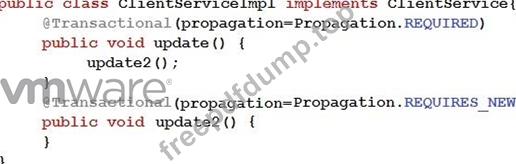
Assume that the application is using Spring transaction management which uses Spring AOP internally.
Choose the statement that describes what is happening when the update1 method is called? (Choose the best answer.)
- A. There is only one transaction because REQUIRES_NEW will use an active transaction if one already exists.
- B. There are 2 transactions because REQUIRES_NEW always runs in a new transaction.
- C. There is only one transaction initiated by update1() because the call to update2() does not go through the proxy.
- D. An exception is thrown as another transaction cannot be started within an existing transaction.
Answer: C
Explanation:
When using Spring transaction management with annotation-driven mode, the @Transactional annotation will be processed by a TransactionInterceptor that implements the AOP advice interface. This interceptor will be applied to the target bean through a proxy that implements the same interface as the target bean. Therefore, when a method of the target bean is called from outside, it will actually invoke the proxy method, which will delegate to the interceptor and then to the actual target method.
However, when a method of the target bean is called from within the same bean, it will not go through the proxy and thus bypass the interceptor logic. In this case, when update1() calls update2(), it will not start a new transaction as specified by REQUIRES_NEW propagation level, but rather join the existing transaction initiated by update1() itself.
NEW QUESTION # 38
Which two statements about pointcut expressions are true? (Choose two.)
- A. A pointcut expression can be used to select join points which have been annotated with a specific annotation.
- B. A pointcut expression cannot specify the type of parameters.
- C. A pointcut expression will throw an exception if no methods are matched.
- D. A pointcut expression can include operators such as the following: && (and), || (or), ! (not).
- E. A pointcut expression cannot have a wildcard for a method name.
Answer: A,D
Explanation:
https://docs.spring.io/spring-framework/reference/core/aop/ataspectj/pointcuts.html
NEW QUESTION # 39
......
Ultimate 2V0-72.22 Guide to Prepare Free Latest VMware Practice Tests Dumps: https://www.freepdfdump.top/2V0-72.22-valid-torrent.html
Get Top-Rated VMware 2V0-72.22 Exam Dumps Now: https://drive.google.com/open?id=1bZv7LNpZaARLMX4z93ErSzrrjMXJMp3Y
