

Latest [Nov 03, 2021] 100% Passing Guarantee - Brilliant AZ-500 Exam Questions PDF
AZ-500 Certification – Valid Exam Dumps Questions Study Guide! (Updated 295 Questions)
Securing data and applications
- Configuring database security: this requires competency in activating database authentication; activating database auditing; customizing Azure SQL Database Advanced Threat Protection; executing database encryption; performing Azure SQL Database Always Encrypted.
- Configuring and managing Key Vault: the students should know how to manage access to Key Vault; manage permissions to certificates, secrets, and keys; customize RBAC utilization in Azure Key Vault; manage certificates; manage secrets; configure key rotation; backup and restore of Key Vault items.
- Configuring security for storage: the candidates need to demonstrate their abilities in customizing core storage accounts management; customizing Azure AD authentication for Azure Storage; customizing Azure AD Domain Services authentication for Azure Files; designing and managing Shared Access Signatures (SAS); designing shared blob or blob container access policy; customizing Storage Service Encryption.
NEW QUESTION 133
A user named Debbie has the Azure app installed on her mobile device.
You need to ensure that [email protected] is alerted when a resource lock is deleted.
To complete this task, sign in to the Azure portal.
Answer:
Explanation:
See the explanation below.
You need to configure an alert rule in Azure Monitor.
Type Monitor into the search box and select Monitor from the search results.
Click on Alerts.
Click on +New Alert Rule.
In the Scope section, click on the Select resource link.
In the Filter by resource type box, type locks and select Management locks (locks) from the filtered results.
Select the subscription then click the Done button.
In the Condition section, click on the Select condition link.
Select the Delete management locks condition the click the Done button.
In the Action group section, click on the Select action group link.
Click the Create action group button to create a new action group.
Give the group a name such as Debbie Mobile App (it doesn't matter what name you enter for the exam) then click the Next: Notifications > button.
In the Notification type box, select the Email/SMS message/Push/Voice option.
In the Email/SMS message/Push/Voice window, tick the Azure app Push Notifications checkbox and enter [email protected] in the Azure account email field.
Click the OK button to close the window.
Enter a name such as Debbie Mobile App in the notification name box.
Click the Review & Create button then click the Create button to create the action group.
Back in the Create alert rule window, in the Alert rule details section, enter a name such as Management lock deletion in the Alert rule name field.
Click the Create alert rule button to create the alert rule.
NEW QUESTION 134
You need to configure an access review. The review will be assigned to a new collection of reviews and reviewed by resource owners.
Which three actions should you perform in sequence? To answer, move the appropriate actions from the list of actions to the answer area and arrange them in the correct order.
Answer:
Explanation:
Explanation
Step 1: Create an access review program
Step 2: Create an access review control
Step 3: Set Reviewers to Group owners
In the Reviewers section, select either one or more people to review all the users in scope. Or you can select to have the members review their own access. If the resource is a group, you can ask the group owners to review.
References:
https://docs.microsoft.com/en-us/azure/active-directory/governance/create-access-review
https://docs.microsoft.com/en-us/azure/active-directory/governance/manage-programs-controls
NEW QUESTION 135
You have an Azure subscription named Sub1 that contains the resources shown in the following table.
You need to ensure that you can provide VM1 with secure access to a database on SQL1 by using a contained database user.
What should you do?
- A. Create a secret in KV1.
- B. Enable a managed service identity on VM1.
- C. Create a key in KV1.
- D. Configure a service endpoint on SQL1.
Answer: B
Explanation:
Explanation
https://docs.microsoft.com/en-us/azure/active-directory/managed-identities-azure-resources/tutorial-windows-vm
NEW QUESTION 136
You have an Azure subscription that contains the virtual networks shown in the following table.
The Azure virtual machines on SpokeVNetSubnet0 can communicate with the computers on the on-premises network.
You plan to deploy an Azure firewall to HubVNet.
You create the following two routing tables:
* RT1: Includes a user-defined route that points to the private IP address of the Azure firewall as a next hop address
* RT2: Disables BGP route propagation and defines the private IP address of the Azure firewall as the default gateway You need to ensure that traffic between SpokeVNetSubnet0 and the on-premises network flows through the Azure firewall.
To which subnet should you associate each route table? To answer, drag the appropriate subnets to the correct route tables. Each subnet may be used once, more than once, or not at all. You may need to drag the split bar between panes or scroll to view content.
NOTE: Each correct selection is worth one point.
Answer:
Explanation:
Explanation
NEW QUESTION 137
You have an Azure Active Directory (Azure AD) tenant that contains the users shown in the following table.
The tenant contains the named locations shown in the following table.
You create the conditional access policies for a cloud app named App1 as shown in the following table.
For each of the following statements, select Yes if the statement is true. Otherwise, select No.
NOTE: Each correct selection is worth one point.
Answer:
Explanation:
Explanation
NEW QUESTION 138
You have an Azure Active Directory (Azure AD) tenant that contains the users shown in the following table.
From Azure AD Privileged Identity Management (PIM), you configure the settings for the Security Administrator role as shown in the following exhibit.
From PIM, you assign the Security Administrator role to the following groups:
* Group1: Active assignment type, permanently assigned
* Group2: Eligible assignment type, permanently eligible
For each of the following statements, select Yes if the statement is true. Otherwise, select No.
NOTE: Each correct selection is worth one point.
Answer:
Explanation:
Explanation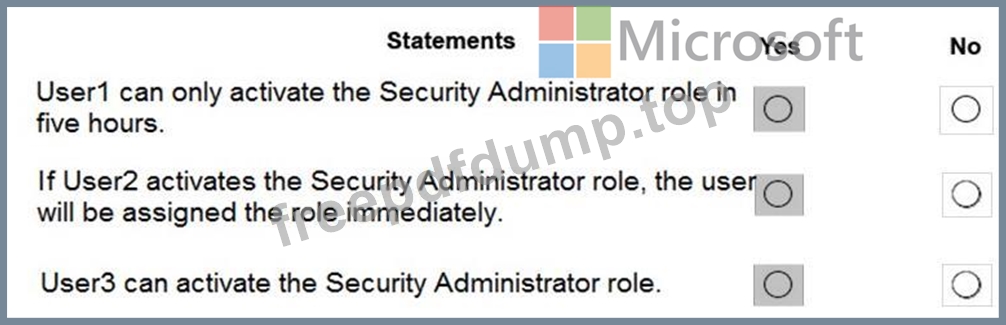
Box 1: Yes
Eligible Type: A role assignment that requires a user to perform one or more actions to use the role. If a user has been made eligible for a role, that means they can activate the role when they need to perform privileged tasks. There's no difference in the access given to someone with a permanent versus an eligible role assignment. The only difference is that some people don't need that access all the time.
You can choose from two assignment duration options for each assignment type (eligible and active) when you configure settings for a role. These options become the default maximum duration when a user is assigned to the role in Privileged Identity Management.
Use the Activation maximum duration slider to set the maximum time, in hours, that a role stays active before it expires. This value can be from one to 24 hours.
Box 2: Yes
Active Type: A role assignment that doesn't require a user to perform any action to use the role. Users assigned as active have the privileges assigned to the role Box 3: Yes User3 is member of Group2.
Reference:
https://docs.microsoft.com/en-us/azure/active-directory/privileged-identity-management/pim-configure
https://docs.microsoft.com/bs-cyrl-ba/azure/active-directory/privileged-identity-management/pim-resource-roles
NEW QUESTION 139
You have an Azure subscription that contains 100 virtual machines. Azure Diagnostics is enabled on all the virtual machines.
You are planning the monitoring of Azure services in the subscription.
You need to retrieve the following details:
Identify the user who deleted a virtual machine three weeks ago.
Query the security events of a virtual machine that runs Windows Server 2016.
What should you use in Azure Monitor? To answer, drag the appropriate configuration settings to the correct details. Each configuration setting may be used once, more than once, or not at all. You may need to drag the split bar between panes or scroll to view content.
NOTE: Each correct selection is worth one point.
Answer:
Explanation:
References:
https://docs.microsoft.com/en-us/azure/security/azure-log-audit
NEW QUESTION 140
You ate evaluating the security of the network communication between the virtual machines in Sub2.
For each of the following statements, select Yes if the statement is true. Otherwise, select No.
NOTE: Each correct selection is worth one point.
Answer:
Explanation:
Explanation
NEW QUESTION 141
You assign User8 the Owner role for RG4, RG5, and RG6.
In which resource groups can User8 create virtual networks and NSGs? To answer, select the appropriate options in the answer area.
NOTE: Each correct selection is worth one point.
Answer:
Explanation:
Explanation
Box 1: RG4 only
Virtual Networks are not allowed for Rg5 and Rg6.
Box 2: Rg4,Rg5, and Rg6
Scenario:
Contoso has two Azure subscriptions named Sub1 and Sub2.
Sub1 contains six resource groups named RG1, RG2, RG3, RG4, RG5, and RG6.
You assign User8 the Owner role for RG4, RG5, and RG6
User8 city Sidney, Role:None
Note: A network security group (NSG) contains a list of security rules that allow or deny network traffic to resources connected to Azure Virtual Networks (VNet). NSGs can be associated to subnets, individual VMs (classic), or individual network interfaces (NIC) attached to VMs (Resource Manager).
References:
https://docs.microsoft.com/en-us/azure/governance/policy/overview
NEW QUESTION 142
You have an Azure subscription named Subscription1 that contains the resources shown in the following table.
You create an Azure role by using the following JSON file.
You assign Role1 to User1 for RG1.
For each of the following statements, select Yes if the statement is true. Otherwise, select No.
NOTE: Each correct selection is worth one point.
Answer:
Explanation:
Reference:
https://docs.microsoft.com/en-us/azure/role-based-access-control/built-in-roles#compute
NEW QUESTION 143
You need to deploy AKS1 to meet the platform protection requirements.
Which four actions should you perform in sequence? To answer, move the appropriate actions from the list of actions to the answer area and arrange them in the correct order.
NOTE: More than one order of answer choices is correct. You will receive credit for any of the correct orders you select.
Answer:
Explanation:
Reference:
https://docs.microsoft.com/en-us/azure/aks/azure-ad-integration
NEW QUESTION 144
You have an Azure subscription that contains a web app named App1 and an Azure key vault named Vault1.
You need to configure App1 to store and access the secrets in Vault1.
How should you configure App1? To answer, select the appropriate options in the answer area.
NOTE: Each correct selection is worth one point.
Answer:
Explanation:
Reference:
https://docs.microsoft.com/en-us/azure/app-service/overview-managed-identity?tabs=dotnet
NEW QUESTION 145
You have an Azure subscription that contains the virtual machines shown in the following table.
From Azure Security Center, you turn on Auto Provisioning.
You deploy the virtual machines shown in the following table.
On which virtual machines is the Log Analytics Agent installed?
- A. VM1, VM2, VM3, and VM4
- B. VM3 only
- C. VM1 and VM3 only
- D. VM3 and VM4 only
Answer: A
Explanation:
When automatic provisioning is On, Security Center provisions the Log Analytics Agent on all supported Azure VMs and any new ones that are created.
Supported Operating systems include: Ubuntu 14.04 LTS (x86/x64), 16.04 LTS (x86/x64), and 18.04 LTS (x64) and Windows Server 2008 R2, 2012, 2012 R2, 2016, version 1709 and 1803 Reference:
https://docs.microsoft.com/en-us/azure/security-center/security-center-enable-data-collection
NEW QUESTION 146
You have an Azure virtual machines shown in the following table.
You create an Azure Log Analytics workspace named Analytics1 in RG1 in the East US region.
Which virtual machines can be enrolled in Analytics1?
- A. VM1 and VM4 only
- B. VM1, VM2, VM3, and VM4
- C. VM1, VM2, and VM3 only
- D. VM1 only
Answer: B
Explanation:
Note: Create a workspace
In the Azure portal, click All services. In the list of resources, type Log Analytics. As you begin typing, the list filters based on your input. Select Log Analytics.
Click Create, and then select choices for the following items:
Provide a name for the new Log Analytics workspace, such as DefaultLAWorkspace. OMS workspaces are now referred to as Log Analytics workspaces.
Select a Subscription to link to by selecting from the drop-down list if the default selected is not appropriate.
For Resource Group, select an existing resource group that contains one or more Azure virtual machines.
Select the Location your VMs are deployed to. For additional information, see which regions Log Analytics is available in.
Incorrect Answers:
B, C: A Log Analytics workspace provides a geographic location for data storage. VM2 and VM3 are at a different location.
D: VM4 is a different resource group.
References:
https://docs.microsoft.com/en-us/azure/azure-monitor/platform/manage-access
NEW QUESTION 147
You have an Azure subscription that contains 100 virtual machines. Azure Diagnostics is enabled on all the virtual machines.
You are planning the monitoring of Azure services in the subscription.
You need to retrieve the following details:
* Identify the user who deleted a virtual machine three weeks ago.
* Query the security events of a virtual machine that runs Windows Server 2016.
What should you use in Azure Monitor? To answer, drag the appropriate configuration settings to the correct details. Each configuration setting may be used once, more than once, or not at all. You may need to drag the split bar between panes or scroll to view content.
NOTE: Each correct selection is worth one point.
Answer:
Explanation:
Explanation
Box1: Activity log
Azure activity logs provide insight into the operations that were performed on resources in your subscription.
Activity logs were previously known as "audit logs" or "operational logs," because they report control-plane events for your subscriptions.
Activity logs help you determine the "what, who, and when" for write operations (that is, PUT, POST, or DELETE).
Box 2: Logs
Log Integration collects Azure diagnostics from your Windows virtual machines, Azure activity logs, Azure Security Center alerts, and Azure resource provider logs. This integration provides a unified dashboard for all your assets, whether they're on-premises or in the cloud, so that you can aggregate, correlate, analyze, and alert for security events.
References:
https://docs.microsoft.com/en-us/azure/security/azure-log-audit
NEW QUESTION 148
Use the following login credentials as needed:
To enter your username, place your cursor in the Sign in box and click on the username below.
To enter your password, place your cursor in the Enter password box and click on the password below.
Azure Username: [email protected]
Azure Password: Ag1Bh9!#Bd
The following information is for technical support purposes only:
Lab Instance: 10598168


You need to prevent HTTP connections to the rg1lod10598168n1 Azure Storage account.
To complete this task, sign in to the Azure portal.
Answer:
Explanation:
See the explanation below.
Explanation
The "Secure transfer required" feature is now supported in Azure Storage account. This feature enhances the security of your storage account by enforcing all requests to your account through a secure connection. This feature is disabled by default.
1. In Azure Portal select you Azure Storage account rg1lod10598168n1.
2. Select Configuration, and Secure Transfer required.
Reference:
https://techcommunity.microsoft.com/t5/Azure/quot-Secure-transfer-required-quot-is-available-in-Azure-Storage
NEW QUESTION 149
You have an Azure subscription that contains an Azure key vault named Vault1.
On January 1, 2019, Vault1 stores the following secrets.
Which can each secret be used by an application? To answer, select the appropriate options in the answer area.
NOTE: Each correct selection is worth one point.
Answer:
Explanation:
Explanation
Box 1: Never
Password1 is disabled.
Box 2: Only between March 1, 2019 and May 1,
Password2:
Reference:
https://docs.microsoft.com/en-us/powershell/module/azurerm.keyvault/set-azurekeyvaultsecretattribute
NEW QUESTION 150
You have an Azure Active Directory (Azure AD) tenant named contoso1812.onmicrosoft.com that contains the users shown in the following table.
You create an Azure Information Protection label named Label1. The Protection settings for Label1 are configured as shown in the exhibit. (Click the Exhibit tab.)
Label1 is applied to a file named File1.
For each of the following statements, select Yes if the statement is true, Otherwise, select No.
NOTE: Each correct selection is worth one point.
Answer:
Explanation:
Explanation
NEW QUESTION 151
Your company has two offices in Seattle and New York. Each office connects to the Internet by using a NAT device. The offices use the IP addresses shown in the following table.
The company has an Azure Active Directory (Azure AD) tenant named contoso.com. The tenant contains the users shown in the following table.
The MFA service settings are configured as shown in the exhibit. (Click the Exhibit tab.)
For each of the following statements, select Yes if the statement is true. Otherwise, select No.
NOTE: Each correct selection is worth one point.
Answer:
Explanation:
Explanation
Box 2: No
Use of Microsoft Authenticator is not required.
Note: Microsoft Authenticator is a multifactor app for mobile devices that generates time-based codes used during the Two-Step Verification process.
Box 3: No
The New York IP address subnet is included in the "skip multi-factor authentication for request.
References:
https://www.cayosoft.com/difference-enabling-enforcing-mfa/
NEW QUESTION 152
You assign User8 the Owner role for RG4, RG5, and RG6.
In which resource groups can User8 create virtual networks and NSGs? To answer, select the appropriate options in the answer area.
NOTE: Each correct selection is worth one point.
Answer:
Explanation:
Explanation
Box 1: RG4 only
Virtual Networks are not allowed for Rg5 and Rg6.
Box 2: Rg4,Rg5, and Rg6
Scenario:
Contoso has two Azure subscriptions named Sub1 and Sub2.
Sub1 contains six resource groups named RG1, RG2, RG3, RG4, RG5, and RG6.
You assign User8 the Owner role for RG4, RG5, and RG6
User8 city Sidney, Role:None
Note: A network security group (NSG) contains a list of security rules that allow or deny network traffic to resources connected to Azure Virtual Networks (VNet). NSGs can be associated to subnets, individual VMs (classic), or individual network interfaces (NIC) attached to VMs (Resource Manager).
References:
https://docs.microsoft.com/en-us/azure/governance/policy/overview
NEW QUESTION 153
You have Azure Resource Manager templates that you use to deploy Azure virtual machines.
You need to disable unused Windows features automatically as instances of the virtual machines are provisioned.
What should you use?
- A. Azure Logic Apps
- B. security policies in Azure Security Center
- C. device configuration policies in Microsoft Intune
- D. an Azure Desired State Configuration (DSC) virtual machine extension
Answer: D
Explanation:
The primary use case for the Azure Desired State Configuration (DSC) extension is to bootstrap a VM to the Azure Automation State Configuration (DSC) service. The service provides benefits that include ongoing management of the VM configuration and integration with other operational tools, such as Azure Monitoring.
Using the extension to register VM's to the service provides a flexible solution that even works across Azure subscriptions.
Reference:
https://docs.microsoft.com/en-us/azure/virtual-machines/extensions/dsc-overview
https://www.fast2test.com/AZ-500-practice-test.html 44
Valid Fast2test AZ-500 Exam PDF Dumps - New AZ-500 Real Exam Questions
NEW QUESTION 154
You have an Azure subscription named Sub1.
You create a virtual network that contains one subnet. On the subnet, you provision the virtual machines shown in the following table.
Currently, you have not provisioned any network security groups (NSGs).
You need to implement network security to meet the following requirements:
* Allow traffic to VM4 from VM3 only.
* Allow traffic from the Internet to VM1 and VM2 only.
* Minimize the number of NSGs and network security rules.
How many NSGs and network security rules should you create? To answer, select the appropriate options in the answer area.
NOTE: Each correct selection is worth one point.
Answer:
Explanation:
Explanation
NSGs: 2
Network security rules: 3
Not 2: You cannot specify multiple service tags or application groups) in a security rule.
References:
https://docs.microsoft.com/en-us/azure/virtual-network/security-overview
NEW QUESTION 155
Note: This question is part of a series of questions that present the same scenario. Each question in the series contains a unique solution that might meet the stated goals. Some question sets might have more than one correct solution, while others might not have a correct solution.
After you answer a question in this section, you will NOT be able to return to rt As a result, these questions will not appear in the review screen.
You have an Azure subscription named Sub1.
You have an Azure Storage account named Sa1 in a resource group named RG1.
Users and applications access the blob service and the file service in Sal by using several shared access signatures {SASs) and stored access policies.
You discover that unauthorized users accessed both the rile service and the blob service.
You need to revoke all access to Sa1.
Solution: You regenerate the access keys.
Does this meet the goal?
- A. No
- B. Yes
Answer: A
Explanation:
Instead you should create a new stored access policy.
To revoke a stored access policy, you can either delete it, or rename it by changing the signed identifier. Changing the signed identifier breaks the associations between any existing signatures and the stored access policy. Deleting or renaming the stored access policy immediately affects all of the shared access signatures associated with it.
Reference:
https://docs.microsoft.com/en-us/rest/api/storageservices/Establishing-a-Stored-Access-Policy
NEW QUESTION 156
You need to ensure that connections through an Azure Application Gateway named Homepage-AGW are inspected for malicious requests.
To complete this task, sign in to the Azure portal.
You do not need to wait for the task to complete.
You need to enable the Web Application Firewall on the Application Gateway.
In the Azure portal, type Application gateways in the search box, select Application gateways from the search results then select the gateway named Homepage-AGW. Alternatively, browse to Application Gateways in the left navigation pane.
In the properties of the application gateway, click on Web application firewall.
- A. For the Tier setting, select WAF V2.
- B. Click Save to save the changes.
- C. In the Firewall mode section, click the slider to switch to Prevention.
- D. In the Firewall status section, click the slider to switch to Enabled.
Answer: A
NEW QUESTION 157
......
AZ-500 are Available for Instant Access: https://www.freepdfdump.top/AZ-500-valid-torrent.html
AZ-500 Dumps 2021 - New Microsoft AZ-500 Exam Questions: https://drive.google.com/open?id=1l58TDupl9ZgyvwYNk-3VGfj8bQ7p9KrH
