

Professional-Data-Engineer Dumps To Pass Google Cloud Certified Exam in One Day (Updated 270 Questions)
Professional-Data-Engineer Exam Brain Dumps - Study Notes and Theory
Google Professional-Data-Engineer certification exam is designed to test the knowledge and skills of candidates in the field of data engineering. Professional-Data-Engineer exam is intended for professionals who are responsible for designing, building, and maintaining data processing systems. Professional-Data-Engineer exam is designed to validate the candidate's ability to use Google Cloud Platform technologies to design and implement data processing systems, to build and maintain data structures and databases, and to analyze and optimize data processing workflows.
Exam Overview
The Professional Data Engineer certification exam is a 2-hour test consisting of the multiple-choice and multiple-select questions. The students can take it in the English or Japanese languages. To register for and schedule the exam, you must pay the fee of $200. It is possible to sit for this test in an online proctored format at a remote location. You can also take it as an on-site proctored exam at a designated testing center.
NEW QUESTION # 14
You operate a logistics company, and you want to improve event delivery reliability for vehicle-based sensors. You operate small data centers around the world to capture these events, but leased lines that provide connectivity from your event collection infrastructure to your event processing infrastructure are unreliable, with unpredictable latency. You want to address this issue in the most cost-effective way. What should you do?
- A. Establish a Cloud Interconnect between all remote data centers and Google.
- B. Deploy small Kafka clusters in your data centers to buffer events.
- C. Have the data acquisition devices publish data to Cloud Pub/Sub.
- D. Write a Cloud Dataflow pipeline that aggregates all data in session windows.
Answer: C
NEW QUESTION # 15
MJTelco Case Study
Company Overview
MJTelco is a startup that plans to build networks in rapidly growing, underserved markets around the world.
The company has patents for innovative optical communications hardware. Based on these patents, they can create many reliable, high-speed backbone links with inexpensive hardware.
Company Background
Founded by experienced telecom executives, MJTelco uses technologies originally developed to overcome communications challenges in space. Fundamental to their operation, they need to create a distributed data infrastructure that drives real-time analysis and incorporates machine learning to continuously optimize their topologies. Because their hardware is inexpensive, they plan to overdeploy the network allowing them to account for the impact of dynamic regional politics on location availability and cost.
Their management and operations teams are situated all around the globe creating many-to-many relationship between data consumers and provides in their system. After careful consideration, they decided public cloud is the perfect environment to support their needs.
Solution Concept
MJTelco is running a successful proof-of-concept (PoC) project in its labs. They have two primary needs:
* Scale and harden their PoC to support significantly more data flows generated when they ramp to more than 50,000 installations.
* Refine their machine-learning cycles to verify and improve the dynamic models they use to control topology definition.
MJTelco will also use three separate operating environments - development/test, staging, and production - to meet the needs of running experiments, deploying new features, and serving production customers.
Business Requirements
* Scale up their production environment with minimal cost, instantiating resources when and where needed in an unpredictable, distributed telecom user community.
* Ensure security of their proprietary data to protect their leading-edge machine learning and analysis.
* Provide reliable and timely access to data for analysis from distributed research workers
* Maintain isolated environments that support rapid iteration of their machine-learning models without affecting their customers.
Technical Requirements
* Ensure secure and efficient transport and storage of telemetry data
* Rapidly scale instances to support between 10,000 and 100,000 data providers with multiple flows each.
* Allow analysis and presentation against data tables tracking up to 2 years of data storing approximately
100m records/day
* Support rapid iteration of monitoring infrastructure focused on awareness of data pipeline problems both in telemetry flows and in production learning cycles.
CEO Statement
Our business model relies on our patents, analytics and dynamic machine learning. Our inexpensive hardware is organized to be highly reliable, which gives us cost advantages. We need to quickly stabilize our large distributed data pipelines to meet our reliability and capacity commitments.
CTO Statement
Our public cloud services must operate as advertised. We need resources that scale and keep our data secure. We also need environments in which our data scientists can carefully study and quickly adapt our models. Because we rely on automation to process our data, we also need our development and test environments to work as we iterate.
CFO Statement
The project is too large for us to maintain the hardware and software required for the data and analysis. Also, we cannot afford to staff an operations team to monitor so many data feeds, so we will rely on automation and infrastructure. Google Cloud's machine learning will allow our quantitative researchers to work on our high- value problems instead of problems with our data pipelines.
You create a new report for your large team in Google Data Studio 360. The report uses Google BigQuery as its data source. It is company policy to ensure employees can view only the data associated with their region, so you create and populate a table for each region. You need to enforce the regional access policy to the data.
Which two actions should you take? (Choose two.)
- A. Ensure each table is included in a dataset for a region.
- B. Ensure all the tables are included in global dataset.
- C. Adjust the settings for each view to allow a related region-based security group view access.
- D. Adjust the settings for each table to allow a related region-based security group view access.
- E. Adjust the settings for each dataset to allow a related region-based security group view access.
Answer: A,C
NEW QUESTION # 16
The _________ for Cloud Bigtable makes it possible to use Cloud Bigtable in a Cloud Dataflow pipeline.
- A. BigQuery Data Transfer Service
- B. Cloud Dataflow connector
- C. DataFlow SDK
- D. BiqQuery API
Answer: B
Explanation:
The Cloud Dataflow connector for Cloud Bigtable makes it possible to use Cloud Bigtable in a Cloud Dataflow pipeline. You can use the connector for both batch and streaming operations.
NEW QUESTION # 17
You are creating a model to predict housing prices. Due to budget constraints, you must run it on a single resource-constrained virtual machine. Which learning algorithm should you use?
- A. Logistic classification
- B. Feedforward neural network
- C. Linear regression
- D. Recurrent neural network
Answer: C
NEW QUESTION # 18
When you design a Google Cloud Bigtable schema it is recommended that you _________.
- A. Avoid schema designs that are based on NoSQL concepts
- B. Create schema designs that are based on a relational database design
- C. Create schema designs that require atomicity across rows
- D. Avoid schema designs that require atomicity across rows
Answer: D
Explanation:
All operations are atomic at the row level. For example, if you update two rows in a table, it's possible that one row will be updated successfully and the other update will fail. Avoid schema designs that require atomicity across rows.
NEW QUESTION # 19
You are running a pipeline in Cloud Dataflow that receives messages from a Cloud Pub/Sub topic and writes the results to a BigQuery dataset in the EU. Currently, your pipeline is located in europe-west4 and has a maximum of 3 workers, instance type n1-standard-1. You notice that during peak periods, your pipeline is struggling to process records in a timely fashion, when all 3 workers are at maximum CPU utilization. Which two actions can you take to increase performance of your pipeline? (Choose two.)
- A. Use a larger instance type for your Cloud Dataflow workers
- B. Create a temporary table in Cloud Bigtable that will act as a buffer for new data. Create a new step in your pipeline to write to this table first, and then create a new pipeline to write from Cloud Bigtable to BigQuery
- C. Create a temporary table in Cloud Spanner that will act as a buffer for new data. Create a new step in your pipeline to write to this table first, and then create a new pipeline to write from Cloud Spanner to BigQuery
- D. Increase the number of max workers
- E. Change the zone of your Cloud Dataflow pipeline to run in us-central1
Answer: A,C
NEW QUESTION # 20
Cloud Bigtable is Google's ______ Big Data database service.
- A. NoSQL
- B. Relational
- C. SQL Server
- D. mySQL
Answer: A
Explanation:
Explanation
Cloud Bigtable is Google's NoSQL Big Data database service. It is the same database that Google uses for services, such as Search, Analytics, Maps, and Gmail.
It is used for requirements that are low latency and high throughput including Internet of Things (IoT), user analytics, and financial data analysis.
Reference: https://cloud.google.com/bigtable/
NEW QUESTION # 21
MJTelco Case Study
Company Overview
MJTelco is a startup that plans to build networks in rapidly growing, underserved markets around the world.
The company has patents for innovative optical communications hardware. Based on these patents, they can create many reliable, high-speed backbone links with inexpensive hardware.
Company Background
Founded by experienced telecom executives, MJTelco uses technologies originally developed to overcome communications challenges in space. Fundamental to their operation, they need to create a distributed data infrastructure that drives real-time analysis and incorporates machine learning to continuously optimize their topologies. Because their hardware is inexpensive, they plan to overdeploy the network allowing them to account for the impact of dynamic regional politics on location availability and cost.
Their management and operations teams are situated all around the globe creating many-to-many relationship between data consumers and provides in their system. After careful consideration, they decided public cloud is the perfect environment to support their needs.
Solution Concept
MJTelco is running a successful proof-of-concept (PoC) project in its labs. They have two primary needs:
* Scale and harden their PoC to support significantly more data flows generated when they ramp to more than 50,000 installations.
* Refine their machine-learning cycles to verify and improve the dynamic models they use to control topology definition.
MJTelco will also use three separate operating environments - development/test, staging, and production - to meet the needs of running experiments, deploying new features, and serving production customers.
Business Requirements
* Scale up their production environment with minimal cost, instantiating resources when and where needed in an unpredictable, distributed telecom user community.
* Ensure security of their proprietary data to protect their leading-edge machine learning and analysis.
* Provide reliable and timely access to data for analysis from distributed research workers
* Maintain isolated environments that support rapid iteration of their machine-learning models without affecting their customers.
Technical Requirements
* Ensure secure and efficient transport and storage of telemetry data
* Rapidly scale instances to support between 10,000 and 100,000 data providers with multiple flows each.
* Allow analysis and presentation against data tables tracking up to 2 years of data storing approximately
100m records/day
* Support rapid iteration of monitoring infrastructure focused on awareness of data pipeline problems both in telemetry flows and in production learning cycles.
CEO Statement
Our business model relies on our patents, analytics and dynamic machine learning. Our inexpensive hardware is organized to be highly reliable, which gives us cost advantages. We need to quickly stabilize our large distributed data pipelines to meet our reliability and capacity commitments.
CTO Statement
Our public cloud services must operate as advertised. We need resources that scale and keep our data secure. We also need environments in which our data scientists can carefully study and quickly adapt our models. Because we rely on automation to process our data, we also need our development and test environments to work as we iterate.
CFO Statement
The project is too large for us to maintain the hardware and software required for the data and analysis. Also, we cannot afford to staff an operations team to monitor so many data feeds, so we will rely on automation and infrastructure. Google Cloud's machine learning will allow our quantitative researchers to work on our high- value problems instead of problems with our data pipelines.
MJTelco needs you to create a schema in Google Bigtable that will allow for the historical analysis of the last 2 years of records. Each record that comes in is sent every 15 minutes, and contains a unique identifier of the device and a data record. The most common query is for all the data for a given device for a given day. Which schema should you use?
- A. Rowkey: data_point
Column data: device_id,date - B. Rowkey: date#device_id
Column data: data_point - C. Rowkey: date
Column data: device_id,data_point - D. Rowkey: device_id
Column data: date, data_point - E. Rowkey: date#data_point
Column data: device_id
Answer: A
NEW QUESTION # 22
You want to migrate an on-premises Hadoop system to Cloud Dataproc. Hive is the primary tool in use, and the data format is Optimized Row Columnar (ORC). All ORC files have been successfully copied to a Cloud Storage bucket. You need to replicate some data to the cluster's local Hadoop Distributed File System (HDFS) to maximize performance. What are two ways to start using Hive in Cloud Dataproc? (Choose two.)
- A. Run the gsutil utility to transfer all ORC files from the Cloud Storage bucket to HDFS. Mount the Hive tables locally.
- B. Load the ORC files into BigQuery. Leverage BigQuery connector for Hadoop to mount the BigQuery tables as external Hive tables. Replicate external Hive tables to the native ones.
- C. Run the gsutil utility to transfer all ORC files from the Cloud Storage bucket to any node of the Dataproc cluster. Mount the Hive tables locally.
- D. Run the gsutil utility to transfer all ORC files from the Cloud Storage bucket to the master node of the Dataproc cluster. Then run the Hadoop utility to copy them do HDFS. Mount the Hive tables from HDFS.
- E. Leverage Cloud Storage connector for Hadoop to mount the ORC files as external Hive tables. Replicate external Hive tables to the native ones.
Answer: C,D
NEW QUESTION # 23
What is the recommended action to do in order to switch between SSD and HDD storage for your Google Cloud Bigtable instance?
- A. run parallel instances where one is HDD and the other is SDD
- B. the selection is final and you must resume using the same storage type
- C. export the data from the existing instance and import the data into a new instance
- D. create a third instance and sync the data from the two storage types via batch jobs
Answer: C
Explanation:
When you create a Cloud Bigtable instance and cluster, your choice of SSD or HDD storage for the cluster is permanent. You cannot use the Google Cloud Platform Console to change the type of storage that is used for the cluster.
If you need to convert an existing HDD cluster to SSD, or vice-versa, you can export the data from the existing instance and import the data into a new instance. Alternatively, you can write
a Cloud Dataflow or Hadoop MapReduce job that copies the data from one instance to another.
NEW QUESTION # 24
To give a user read permission for only the first three columns of a table, which access control method would you use?
- A. Authorized view
- B. Primitive role
- C. It's not possible to give access to only the first three columns of a table.
- D. Predefined role
Answer: A
Explanation:
Explanation
An authorized view allows you to share query results with particular users and groups without giving them read access to the underlying tables. Authorized views can only be created in a dataset that does not contain the tables queried by the view.
When you create an authorized view, you use the view's SQL query to restrict access to only the rows and columns you want the users to see.
Reference: https://cloud.google.com/bigquery/docs/views#authorized-views
NEW QUESTION # 25
You want to automate execution of a multi-step data pipeline running on Google Cloud. The pipeline includes Cloud Dataproc and Cloud Dataflow jobs that have multiple dependencies on each other. You want to use managed services where possible, and the pipeline will run every day. Which tool should you use?
- A. cron
- B. Cloud Composer
- C. Cloud Scheduler
- D. Workflow Templates on Cloud Dataproc
Answer: B
NEW QUESTION # 26
Your infrastructure includes a set of YouTube channels. You have been tasked with creating a process for sending the YouTube channel data to Google Cloud for analysis. You want to design a solution that allows your world-wide marketing teams to perform ANSI SQL and other types of analysis on up-to-date YouTube channels log dat
a. How should you set up the log data transfer into Google Cloud?
- A. Use Storage Transfer Service to transfer the offsite backup files to a Cloud Storage Regional bucket as a final destination.
- B. Use BigQuery Data Transfer Service to transfer the offsite backup files to a Cloud Storage Regional
- C. Use BigQuery Data Transfer Service to transfer the offsite backup files to a Cloud Storage Multi-Regional storage bucket as a final destination.
- D. Use Storage Transfer Service to transfer the offsite backup files to a Cloud Storage Multi-Regional storage bucket as a final destination.
Answer: A
Explanation:
storage bucket as a final destination.
NEW QUESTION # 27
Which row keys are likely to cause a disproportionate number of reads and/or writes on a particular node in a Bigtable cluster (select 2 answers)?
- A. A sequential numeric ID
- B. A timestamp followed by a stock symbol
- C. A non-sequential numeric ID
- D. A stock symbol followed by a timestamp
Answer: A,B
Explanation:
...using a timestamp as the first element of a row key can cause a variety of problems. In brief, when a row key for a time series includes a timestamp, all of your writes will target a single node; fill that node; and then move onto the next node in the cluster, resulting in hotspotting. Suppose your system assigns a numeric ID to each of your application's users. You might be tempted to use the user's numeric ID as the row key for your table. However, since new users are more likely to be active users, this approach is likely to push most of your traffic to a small number of nodes. [https://cloud.google.com/bigtable/docs/schema- design] Reference: https://cloud.google.com/bigtable/docs/schema-design-time- series#ensure_that_your_row_key_avoids_hotspotting
NEW QUESTION # 28
You decided to use Cloud Datastore to ingest vehicle telemetry data in real time. You want to build a storage system that will account for the long-term data growth, while keeping the costs low. You also want to create snapshots of the data periodically, so that you can make a point-in-time (PIT) recovery, or clone a copy of the data for Cloud Datastore in a different environment. You want to archive these snapshots for a long time. Which two methods can accomplish this? Choose 2 answers.
- A. Write an application that uses Cloud Datastore client libraries to read all the entities. Format the exported data into a JSON file. Apply compression before storing the data in Cloud Source Repositories.
- B. Use managed export, and then import the data into a BigQuery table created just for that export, and delete temporary export files.
- C. Use managed export, and store the data in a Cloud Storage bucket using Nearline or Coldline class.
- D. Write an application that uses Cloud Datastore client libraries to read all the entities. Treat each entity as a BigQuery table row via BigQuery streaming insert. Assign an export timestamp for each export, and attach it as an extra column for each row. Make sure that the BigQuery table is partitioned using the export timestamp column.
- E. Use managed exportm, and then import to Cloud Datastore in a separate project under a unique namespace reserved for that export.
Answer: A,B
NEW QUESTION # 29
You set up a streaming data insert into a Redis cluster via a Kafka cluster. Both clusters are running on
Compute Engine instances. You need to encrypt data at rest with encryption keys that you can create, rotate, and destroy as needed. What should you do?
- A. Create encryption keys in Cloud Key Management Service. Reference those keys in your API service calls when accessing the data in your Compute Engine cluster instances.
- B. Create encryption keys locally. Upload your encryption keys to Cloud Key Management Service. Use those keys to encrypt your data in all of the Compute Engine cluster instances.
- C. Create encryption keys in Cloud Key Management Service. Use those keys to encrypt your data in all of the Compute Engine cluster instances.
- D. Create a dedicated service account, and use encryption at rest to reference your data stored in your
Compute Engine cluster instances as part of your API service calls.
Answer: B
NEW QUESTION # 30
MJTelco Case Study
Company Overview
MJTelco is a startup that plans to build networks in rapidly growing, underserved markets around the world. The company has patents for innovative optical communications hardware. Based on these patents, they can create many reliable, high-speed backbone links with inexpensive hardware.
Company Background
Founded by experienced telecom executives, MJTelco uses technologies originally developed to overcome communications challenges in space. Fundamental to their operation, they need to create a distributed data infrastructure that drives real-time analysis and incorporates machine learning to continuously optimize their topologies. Because their hardware is inexpensive, they plan to overdeploy the network allowing them to account for the impact of dynamic regional politics on location availability and cost.
Their management and operations teams are situated all around the globe creating many-to-many relationship between data consumers and provides in their system. After careful consideration, they decided public cloud is the perfect environment to support their needs.
Solution Concept
MJTelco is running a successful proof-of-concept (PoC) project in its labs. They have two primary needs:
Scale and harden their PoC to support significantly more data flows generated when they ramp to more
than 50,000 installations.
Refine their machine-learning cycles to verify and improve the dynamic models they use to control
topology definition.
MJTelco will also use three separate operating environments - development/test, staging, and production
- to meet the needs of running experiments, deploying new features, and serving production customers.
Business Requirements
Scale up their production environment with minimal cost, instantiating resources when and where
needed in an unpredictable, distributed telecom user community.
Ensure security of their proprietary data to protect their leading-edge machine learning and analysis.
Provide reliable and timely access to data for analysis from distributed research workers
Maintain isolated environments that support rapid iteration of their machine-learning models without
affecting their customers.
Technical Requirements
Ensure secure and efficient transport and storage of telemetry data
Rapidly scale instances to support between 10,000 and 100,000 data providers with multiple flows each.
Allow analysis and presentation against data tables tracking up to 2 years of data storing approximately
100m records/day
Support rapid iteration of monitoring infrastructure focused on awareness of data pipeline problems both in telemetry flows and in production learning cycles.
CEO Statement
Our business model relies on our patents, analytics and dynamic machine learning. Our inexpensive hardware is organized to be highly reliable, which gives us cost advantages. We need to quickly stabilize our large distributed data pipelines to meet our reliability and capacity commitments.
CTO Statement
Our public cloud services must operate as advertised. We need resources that scale and keep our data secure. We also need environments in which our data scientists can carefully study and quickly adapt our models. Because we rely on automation to process our data, we also need our development and test environments to work as we iterate.
CFO Statement
The project is too large for us to maintain the hardware and software required for the data and analysis.
Also, we cannot afford to staff an operations team to monitor so many data feeds, so we will rely on automation and infrastructure. Google Cloud's machine learning will allow our quantitative researchers to work on our high-value problems instead of problems with our data pipelines.
MJTelco is building a custom interface to share data. They have these requirements:
1. They need to do aggregations over their petabyte-scale datasets.
2. They need to scan specific time range rows with a very fast response time (milliseconds).
Which combination of Google Cloud Platform products should you recommend?
- A. BigQuery and Cloud Storage
- B. Cloud Bigtable and Cloud SQL
- C. Cloud Datastore and Cloud Bigtable
- D. BigQuery and Cloud Bigtable
Answer: D
NEW QUESTION # 31
You want to archive data in Cloud Storage. Because some data is very sensitive, you want to use the "Trust No One" (TNO) approach to encrypt your data to prevent the cloud provider staff from decrypting your data.
What should you do?
- A. Specify customer-supplied encryption key (CSEK) in the .boto configuration file. Use gsutil cp to upload each archival file to the Cloud Storage bucket. Save the CSEK in Cloud Memorystore as permanent storage of the secret.
- B. Use gcloud kms keys create to create a symmetric key. Then use gcloud kms encrypt to encrypt each archival file with the key. Use gsutil cp to upload each encrypted file to the Cloud Storage bucket.
Manually destroy the key previously used for encryption, and rotate the key once and rotate the key once. - C. Specify customer-supplied encryption key (CSEK) in the .boto configuration file. Use gsutil cp to upload each archival file to the Cloud Storage bucket. Save the CSEK in a different project that only the security team can access.
- D. Use gcloud kms keys create to create a symmetric key. Then use gcloud kms encrypt to encrypt each archival file with the key and unique additional authenticated data (AAD). Use gsutil cp to upload each encrypted file to the Cloud Storage bucket, and keep the AAD outside of Google Cloud.
Answer: B
NEW QUESTION # 32
You are deploying a new storage system for your mobile application, which is a media streaming service. You decide the best fit is Google Cloud Datastore. You have entities with multiple properties, some of which can take on multiple values. For example, in the entity 'Movie' the property 'actors' and the property 'tags' have multiple values but the property 'date released' does not. A typical query would ask for all movies with actor=<actorname> ordered by date_released or all movies with tag=Comedy ordered by date_released. How should you avoid a combinatorial explosion in the number of indexes?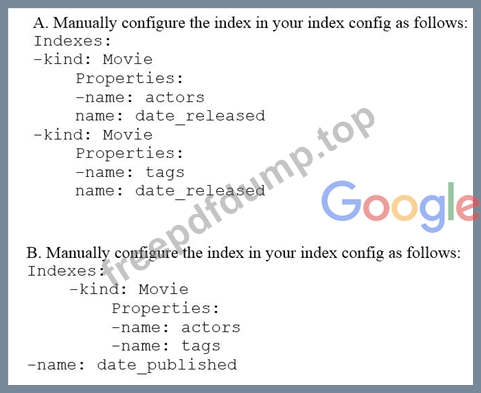

- A. Option B.
- B. Option C
- C. Option D
- D. Option A
Answer: D
NEW QUESTION # 33
Which of the following is NOT a valid use case to select HDD (hard disk drives) as the storage for Google Cloud Bigtable?
- A. You will not use the data to back a user-facing or latency-sensitive application.
- B. You expect to store at least 10 TB of data.
- C. You will mostly run batch workloads with scans and writes, rather than frequently executing random reads of a small number of rows.
- D. You need to integrate with Google BigQuery.
Answer: D
Explanation:
For example, if you plan to store extensive historical data for a large number of remote- sensing devices and then use the data to generate daily reports, the cost savings for HDD storage may justify the performance tradeoff. On the other hand, if you plan to use the data to display a real-time dashboard, it probably would not make sense to use HDD storage-reads would be much more frequent in this case, and reads are much slower with HDD storage.
Reference: https://cloud.google.com/bigtable/docs/choosing-ssd-hdd
NEW QUESTION # 34
Your company receives both batch- and stream-based event data. You want to process the data using Google Cloud Dataflow over a predictable time period. However, you realize that in some instances data can arrive late or out of order. How should you design your Cloud Dataflow pipeline to handle data that is late or out of order?
- A. Use watermarks and timestamps to capture the lagged data.
- B. Set a single global window to capture all the data.
- C. Ensure every datasource type (stream or batch) has a timestamp, and use the timestamps to define the logic for lagged data.
- D. Set sliding windows to capture all the lagged data.
Answer: A
Explanation:
A watermark is a threshold that indicates when Dataflow expects all of the data in a window to have arrived. If new data arrives with a timestamp that's in the window but older than the watermark, the data is considered late data.
NEW QUESTION # 35
You have Cloud Functions written in Node.js that pull messages from Cloud Pub/Sub and send the data to BigQuery. You observe that the message processing rate on the Pub/Sub topic is orders of magnitude higher than anticipated, but there is no error logged in Stackdriver Log Viewer. What are the two most likely causes of this problem? Choose 2 answers.
- A. The subscriber code does not acknowledge the messages that it pulls.
- B. Total outstanding messages exceed the 10-MB maximum.
- C. The subscriber code cannot keep up with the messages.
- D. Publisher throughput quota is too small.
- E. Error handling in the subscriber code is not handling run-time errors properly.
Answer: C,E
NEW QUESTION # 36
......
Professional-Data-Engineer Dumps PDF - Want To Pass Professional-Data-Engineer Fast: https://www.freepdfdump.top/Professional-Data-Engineer-valid-torrent.html
100% Guaranteed Results Professional-Data-Engineer Unlimited 270 Questions: https://drive.google.com/open?id=1cl7VVLOyEs9gRCTx6WU7uyre2goeH6Fy
